← Back to Gallery

Leonardo's Renaissance Ensemble New

Physics-Based Audio Synthesis • Algorithmic Renaissance Composition • Court Music Demo

.gnitniap fo retsis eht si cisuM
Hover to decode Leonardo's wisdom
"Music may be called the sister of painting, for her harmony is composed of the union of proportional parts sounded simultaneously."
— Leonardo da Vinci, Trattato della Pittura
COMPOSIZIONE
Algorithmic Composition
Renaissance music composed in period church modes using algorithmic voice-leading rules
FISICA
Physics Timbres
6 instruments with authentic harmonic profiles & ADSR envelopes
RIVERBERO
Hall Reverb
Schroeder reverb simulation for immersive court acoustics
VISUALE
Visualizations
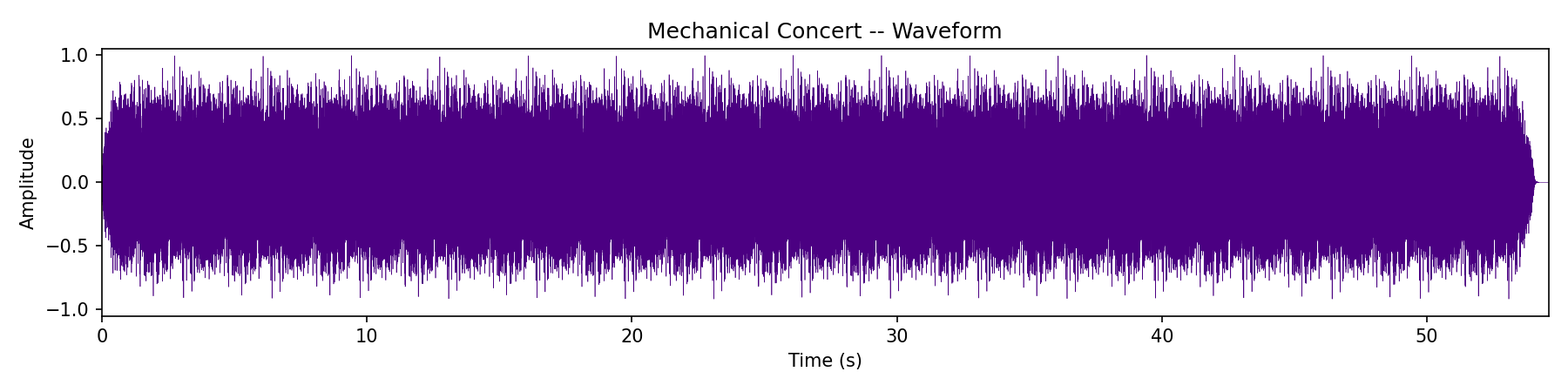
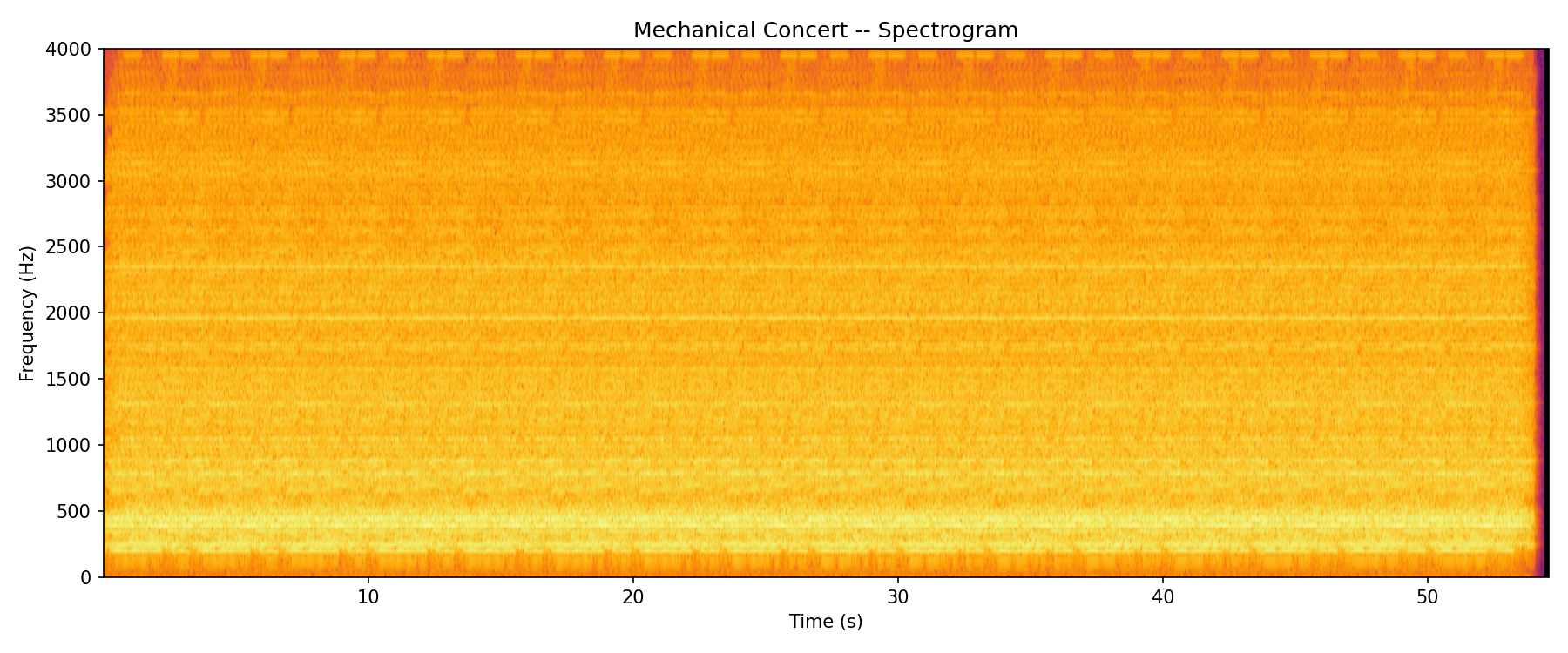
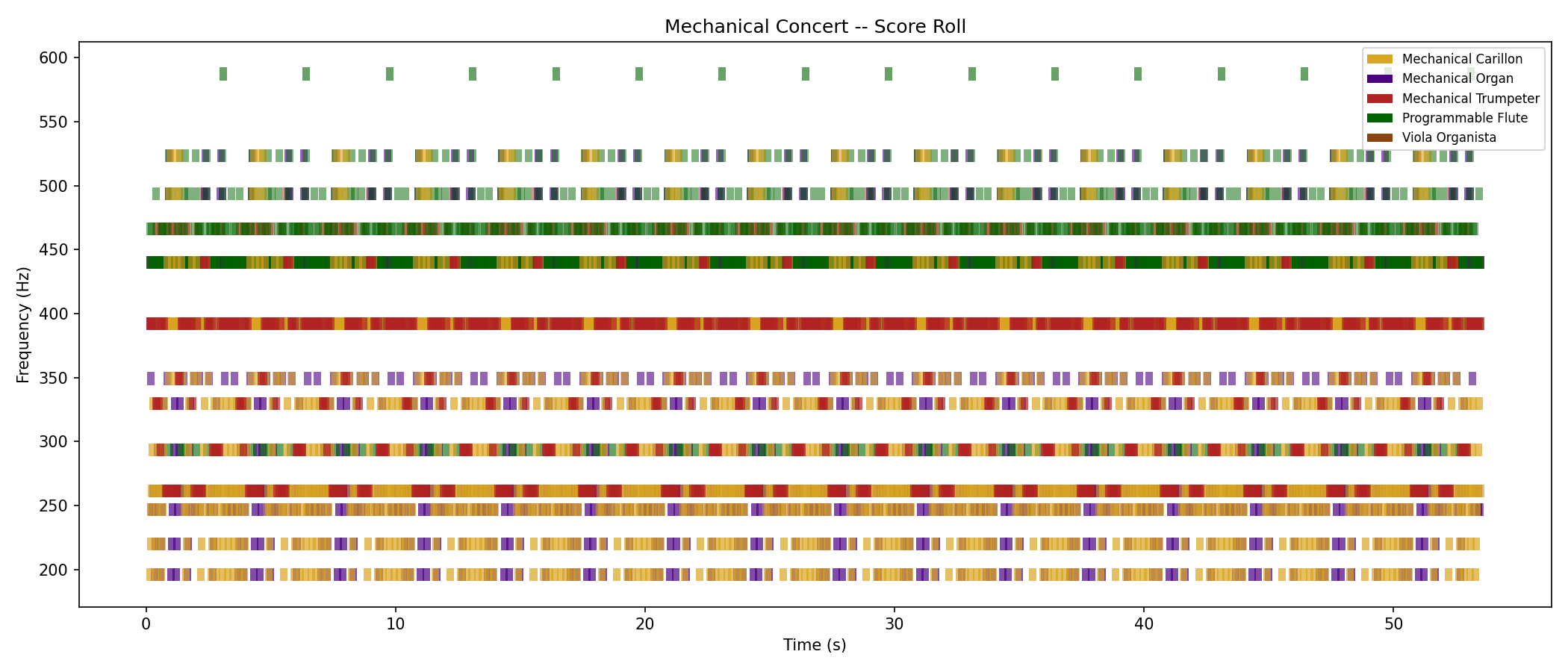
Waveform, spectrogram & score roll analysis of generated audio

Demo: Pavane in Dorian Mode

Algorithmically composed Renaissance music performed by 6 physics-based mechanical instruments

"Pavane for Mechanical Ensemble" 16 measures • 72 BPM • Dorian mode • Seed 42

Physics-Based Instrument Timbres

Each instrument is synthesized from physical principles, not samples. Authentic harmonic profiles, ADSR envelopes, and mechanical noise characteristics.

sonoro
V.O.
Viola Organista
Bowed String Keyboard
Harmonics: [1, 2, 3, 4, 5, 6, 7, 8]
Weights: [1.0, 0.3, 0.7, 0.15, 0.5, 0.1, 0.35, 0.08]
ADSR: Attack 80ms, Decay 60ms, Sustain 75%, Release 150ms
Effects: 5Hz vibrato (12 cents), 3% pink noise
Click to hear
spirto
Org.
Mechanical Organ
Pipe Organ
Harmonics: [1, 2, 3, 4, 5, 6, 7, 8]
Weights: 1/n series [1, 0.5, 0.33, 0.25...]
ADSR: Attack 50ms, Decay 30ms, Sustain 95%, Release 80ms
Effects: 2% breath noise, steady pipe character
Click to hear
dolce
Fl.
Programmable Flute
Recorder / Flauto
Harmonics: [1, 2, 3, 4, 5]
Weights: [1.0, 0.35, 0.15, 0.08, 0.03]
ADSR: Attack 40ms, Decay 50ms, Sustain 70%, Release 120ms
Effects: 4.5Hz vibrato (8 cents), 8% breath noise
Click to hear
campana
Car.
Mechanical Carillon
Bell System
Harmonics: [1, 2.4, 3.9, 5.4, 6.7, 8.2]
Weights: [1.0, 0.6, 0.4, 0.25, 0.15, 0.08]
ADSR: Attack 1ms, Decay 300ms, Sustain 15%, Release 1.5s
Effects: Inharmonic bell partials, long release
Click to hear
chiaro
Tr.
Mechanical Trumpeter
Brass Automaton
Harmonics: [1, 2, 3, 4, 5, 6, 7, 8]
Weights: [1.0, 0.8, 0.6, 0.55, 0.5, 0.4, 0.3, 0.2]
ADSR: Attack 30ms, Decay 40ms, Sustain 85%, Release 100ms
Effects: 5.5Hz vibrato (15 cents), 4% breath noise
Click to hear
ritmo
Dr.
Mechanical Drum
Percussion
Harmonics: Bessel zeros [1, 1.59, 2.14, 2.30, 2.65, 2.92]
Weights: [1.0, 0.7, 0.5, 0.35, 0.2, 0.1]
ADSR: Attack 2ms, Decay 150ms, Sustain 0%, Release 200ms
Effects: 60% white noise burst, drumhead modes
Click to hear
Command-Line Interface

Generate your own Renaissance concerts with the davinci-codex CLI:

$ davinci-codex concert --form pavane --mode dorian --measures 16 --tempo 72 --seed 42 --reverb 0.2
# Concert: pavane in dorian mode, 16 measures @ 72.0 BPM
{
  "artifacts": [
    "artifacts/mechanical_concert/demo/concert_score.json",
    "artifacts/mechanical_concert/demo/concert_audio.wav",
    "artifacts/mechanical_concert/demo/waveform.png",
    "artifacts/mechanical_concert/demo/spectrogram.png",
    "artifacts/mechanical_concert/demo/score_roll.png"
  ],
  "instruments": [
    "viola_organista", "mechanical_organ", "programmable_flute",
    "mechanical_carillon", "mechanical_trumpeter", "mechanical_drum"
  ],
  "total_events": 7680
}
Available Forms: pavane, galliard, basse_danse, chanson, madrigal, motet, isorhythmic, fantasia
Available Modes: dorian, phrygian, lydian, mixolydian, hypodorian, hypophrygian, hypolydian, hypomixolydian
V.O.

Viola Organista

Ready
Org.

Mechanical Organ

Ready
Fl.

Programmable Flute

Ready
Car.

Mechanical Carillon

Ready
Tr.

Mechanical Trumpeter

Ready
Dr.

Mechanical Drum

Ready

Renaissance Court Entertainment

Leonardo's mechanical instruments were designed for the sophisticated courts of Renaissance Italy, where musical innovation was a sign of cultural refinement and technical mastery.

These automata represented the perfect fusion of art and engineering, capable of performing complex musical compositions without human musicians - a marvel that would have astonished contemporary audiences.

The Pavane you hear in the demo was a slow processional dance popular in European courts during the 16th century, while the Dorian mode was one of the church modes favored for its solemn, contemplative character.

Engineering Principles

Leonardo's mechanical instruments relied on several key innovations:

  • Pinned Cylinders: Rotating barrels with strategically placed pins to trigger mechanical actions
  • Cam Mechanisms: Precisely shaped profiles to convert rotary motion into complex movements
  • Bellows Systems: Automated air pressure regulation for wind instruments
  • Gear Trains: Complex gearing for timing and synchronization

Physics-Based Audio Synthesis

Unlike modern digital instruments that use recorded samples, our Renaissance Ensemble generates sound from first principles:

  • Additive Synthesis: Each note is built from harmonic partials with instrument-specific weights
  • ADSR Envelopes: Attack, Decay, Sustain, Release curves match mechanical response times
  • Noise Modeling: Mechanical noise (breath, bow friction, drum impact) adds authenticity
  • Schroeder Reverb: 4 comb filters + 2 allpass filters simulate Renaissance hall acoustics
  • Vibrato: Pitch modulation at 4-6Hz mimics human performance characteristics

Leonardo da Vinci (1452-1519)

Leonardo's musical inventions represent some of his most sophisticated mechanical designs, combining his deep understanding of acoustics with his innovative approach to automation.

Working in the courts of Milan and Florence, Leonardo designed these instruments as both practical entertainment and demonstrations of engineering prowess.

In his Trattato della Pittura, he wrote that "Music may be called the sister of painting, for her harmony is composed of the union of proportional parts sounded simultaneously" -- reflecting his belief that music, like all natural phenomena, could be understood through mathematical principles.

Preparing Leonardo's Mechanical Ensemble...

.gnitniap fo retsis eht si cisuM
Hover to decode

"Music may be called the sister of painting."

— Leonardo da Vinci, Trattato della Pittura

Tuning the instruments...